
Read the situation
Open the files to understand the deadline, the people involved and the decision.
Inside a simulation
Play online with an AI assistant that is sometimes wrong. Get feedback on whether you met the case rules.
Available now. No account.
Team sessions give you a decision record and feedback on the case's rules; your trainer or company learning team leads a discussion to agree actions.
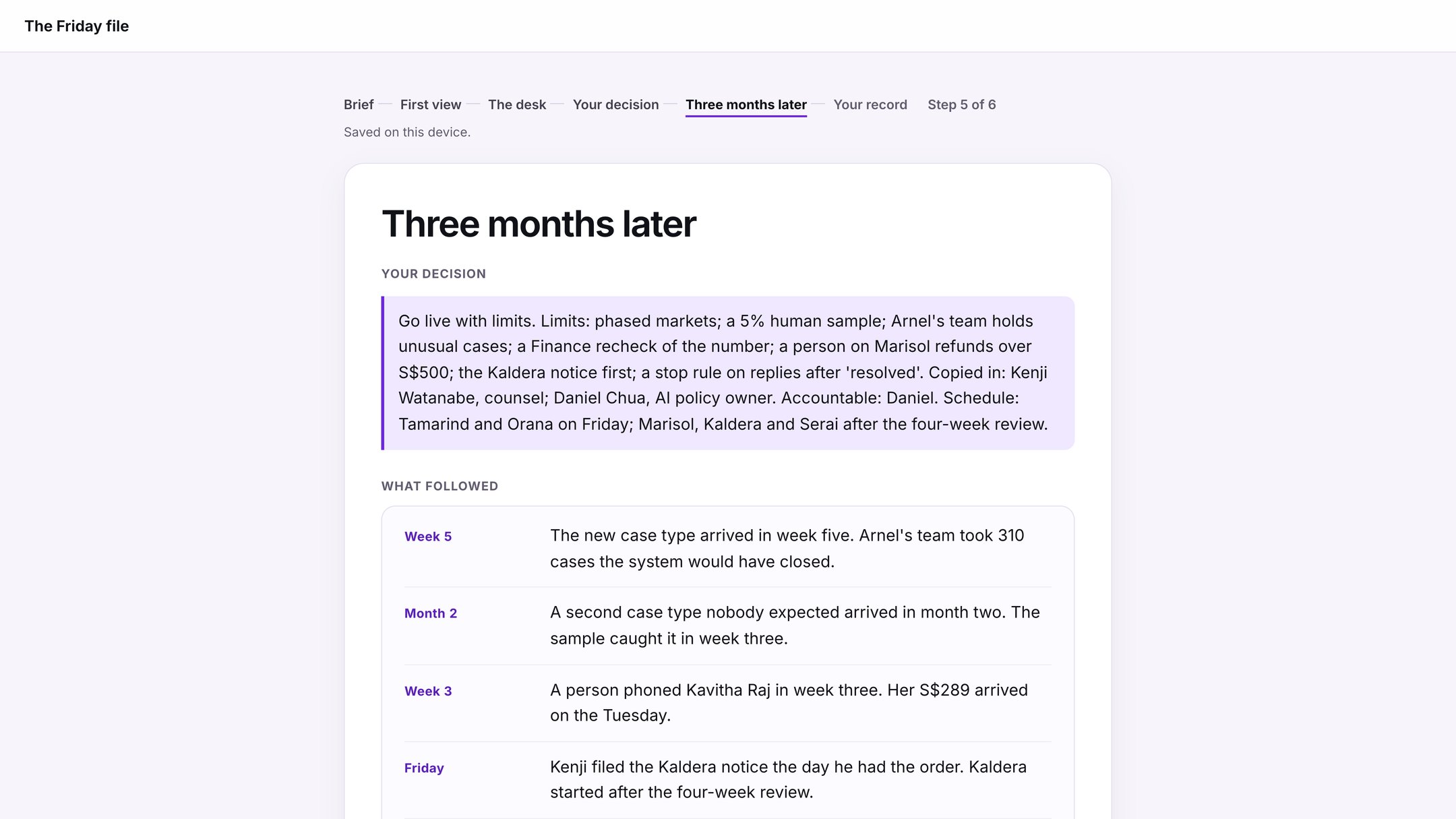
You are a manager at a fictional company, deciding whether a customer system should enter use on Friday.
Open the files to understand the deadline, the people involved and the decision.
The AI assistant makes a recommendation that may be right or wrong.
Choose what to investigate, ask colleagues for information and decide whether to accept or challenge the advice.
The story moves forward to show what followed your decision.
A decision record lists what you opened, asked, challenged, accepted and decided.
Feedback shows which written rules were met, with the recorded actions behind each reading.
In real work, an AI answer may look reasonable long before anyone discovers whether it was right.
StepSim's cases have known evidence and written rules. The AI's advice is sometimes sound and sometimes flawed. The case records whether you checked it, used it or overruled it, so the debrief can examine whether that choice was supported.
Accepting every answer and rejecting every answer can both lead you astray. The practice is in deciding which advice deserves your trust.
Two people can reach the same decision through different actions. One may check the deciding fact; another may never open it. Their records make that difference visible.
StepSim also keeps the quality of the decision apart from what happened afterwards. A sound decision can be unlucky. A weak decision can turn out well.
The feedback shows the actions and the case rules behind its reading. Written rules assess recorded actions. An AI model does not grade you.
Same case. Same luck. In Route A the desk was checked before the decision. In Route B it was not. "Strong" and "weak" are read against the case author's written rules, from what was done in this run. The record shows the route.
Sent: go live with limits, at hour 7. Copied in: Kenji. Accountable: Daniel.
The case's luck
In this run, the process was strong. The outcome was good. The case's name for this is an earned success.
In this run, the process was strong. The outcome was bad: year one came in under 60% of the number the board holds. The case's name for this is a defensible loss.
Sent: go live Friday, at hour 0. Nobody copied in. Nobody named accountable.
The case's luck
In this run, the process was weak. The outcome was bad. The case's name for this is an avoidable failure.
In this run, the process was weak. The outcome was good: the board took the number. The case's name for this is a lucky success.
The route does not decide the outcome. The record keeps the two apart, so a sound route is not blamed for bad luck and a lucky one is not praised.
Illustrative example: all four runs are scripted runs, played by StepSim's engine at fixed seeds. The first pair share one seed, so the luck was the same in both; the second pair use other seeds.
When you play The Friday file free, your run stays on your own device.
In a team session, participants are told before they start who sees their named record and how it may be used.
The rules follow the simulation and the published standard for judgment with AI, which looks at checking evidence, questioning advice and taking responsibility for decisions.
Available now
A trainer or learning and development team runs a half-day for 15 to 30 managers, with two simulations and trainer-led discussion. The trainer helps participants agree actions, each with an owner and a date.
Team sessions support development; employee assessment and hiring use a separate assessment.
Register now
AIR APAC issues AIRS-J/1 certification after a separate assessment on StepSim, its official instrument. Practice provides experience and feedback, and does not award certification.
The trainer helps the room work through five questions:
For example, a discussion about an unchecked AI recommendation might lead a team to require a source check before approving its next AI business case. That is an illustrative action; your team chooses its own.
No. You need to read the situation and make business decisions. The case provides the AI assistant and the information. You do not need to configure a tool or write prompts.
For participants, the simulation, feedback and facilitated debrief are the learning experience. A trainer can run the session on its own or include it in an existing AI or leadership programme. There is a separate training programme for facilitators.
Deciding what to do with the information you have: which evidence to check, what advice to use, what risks to accept, when to involve another person and who owns the consequences.
No account or installation is needed to try The Friday file. It runs in your browser. Team sessions use a session code supplied by the facilitator.
The public practice run stays on your device. In a team session, you are told before you start who sees your named record and how it may be used.
No. Participant certification is AIRS-J/1 certification. AIR APAC issues it after a separate assessment on StepSim, its official instrument. A practice run never awards it. See the certification routes.